
FaithFi: Faith & Finance
FaithFi: Faith & FinanceFinance
3.685.00 Reviews
- Version
- 5.1.3
- Installs
- 10.00K
- Age Rating
- Everyone
Screenshots

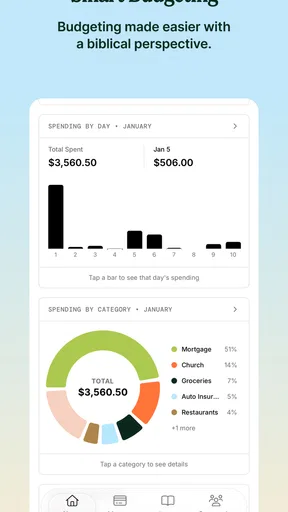


Our Review of FaithFi: Faith & Finance
 Analysis by Appyee
I approached FaithFi: Faith & Finance as a decision rather than a quick download: is it actually useful for someone who wants money guidance connected to Christian faith, or is a conventional budgeting tool likely to do the job better? After spending time with this finance app, my answer is fairly clear. It has a focused purpose, a gentle tone, and a perspective that many ordinary expense trackers do not try to offer. At the same time, that focus is also its main limitation. It will make the most sense to people who want faith to be part of their financial routine, not simply people looking for the most powerful spreadsheet replacement.
What I looked for before recommending it
When I judge a finance app, I first ask whether it helps me make a decision, not merely display information. Can I understand where my money is going? Can I return to the app regularly without feeling overwhelmed? Does it encourage a sensible habit, or does it become another place to collect unfinished tasks? With FaithFi, I added another question: does the religious angle feel genuinely useful in everyday money choices, rather than being a decorative theme?
The app comes from FaithFi: Faith & Finance and is listed in the finance category. Its store summary, “Where Faith Meets Everyday Finances,” describes the central idea accurately, but it does not explain the practical difference that idea makes. In my experience, the value is less about replacing every financial tool and more about giving financial reflection a faith-based frame. That can be meaningful when you are thinking about generosity, contentment, stewardship, or the way spending fits your priorities.
The published average is 3.6 from around 160 ratings, with roughly 85 written reviews. I would read that as a sign to keep expectations realistic rather than as an automatic warning. The app has found an audience, but it is not presented as an unquestionable, universal solution. Its relatively modest reach, at over 10K installs, also suggests that this is a focused product for a particular kind of user rather than a mainstream money manager.
I also considered practical entry requirements. It is free to install, suitable for Everyone, and the current version is 5.1.3. The listed minimum is Android 7.0, so people using older phones should check compatibility before planning around it. Optional in-app purchases range from $3.99 to $11.99 per item, which makes the initial trial less risky, although I would still look carefully at what is included before paying for anything.
The first decision: do you want a faith-centered money routine?
This is the most important filter. If you want a neutral tool that treats money as categories, balances, transactions, and targets, FaithFi may feel too interpretive. If you want an app that helps you connect financial behavior with personal convictions, it has a reason to exist beyond another list of expenses.
I would especially consider it for someone who has tried ordinary budgeting apps but found them emotionally flat. A standard tracker can tell you that restaurant spending rose this month. It usually cannot help you ask whether that spending fits your priorities, whether your giving plan is realistic, or whether your financial goals reflect the life you are trying to build. FaithFi is better suited to that second layer of thinking.
That does not mean the app should replace careful financial judgment. A faith-based perspective can encourage generosity and responsibility, but it should not pressure someone into commitments they cannot afford. My practical rule would be to use the app as a prompt for reflection, then verify important decisions with a clear household budget and, when needed, qualified financial advice.
Where the app earns its place
The strongest part of FaithFi is its identity. It does not ask you to separate your financial life from the values that guide the rest of your life. That matters in ordinary situations: deciding how much to set aside for giving, discussing spending with a spouse, reviewing a difficult month, or trying to reduce impulse purchases without turning the process into self-criticism.
One useful way to approach it is as a weekly conversation starter. I would open it at the same time each week, review recent money choices, and write down one adjustment for the next few days. The important insight is that a faith-oriented finance app works best when it becomes a pause before action, not just a record after action. If you only open it when something goes wrong, you miss much of its potential.
It can also suit households that find purely numerical budgeting arguments unhelpful. Two people may agree on a spending amount but disagree about what matters most. A shared conversation around stewardship and priorities can make the discussion less about who made a mistake and more about what the household wants its money to support. I would not expect the app alone to solve relationship disagreements, but its perspective can provide a more constructive starting point than a bare transaction list.
Another non-obvious strength is that it may help users notice the difference between a financial goal and a financial value. Saving for a purchase is a goal. Practicing contentment, generosity, or responsibility is a value. A conventional finance app is usually strong at the first and silent about the second. FaithFi is most distinctive when it helps you connect the two.
A realistic everyday workflow
Imagine a user who receives income near the start of the month and wants to avoid spending without a plan. Rather than opening the app only after the account is nearly empty, I would begin by identifying essential commitments, a sensible amount for giving, and a modest amount for flexible spending. During the week, I would note purchases that were easy to justify in the moment but did not support the larger plan. At the end of the week, I would review the pattern and choose one change, such as delaying nonessential purchases or moving a planned expense into a clearer category.
The faith element is useful here because it changes the question from “How do I restrict myself?” to “What do I want my money to accomplish?” That is a small shift, but it can make budgeting feel less like punishment. It also creates a practical safeguard: generosity should be planned alongside essentials, not treated as an emotional reaction after every other bill has been paid.
For a couple, I would recommend agreeing on the meaning of the main categories before entering a lot of detail. One person may see a donation as a fixed commitment, while the other sees it as flexible. One may treat convenience spending as harmless, while the other sees it as a recurring leak. Clarifying those assumptions first will save more frustration than endlessly reorganizing entries later.
Where conventional alternatives may fit better
FaithFi is not the obvious choice for everyone. If your priority is automatic account synchronization, detailed investment analysis, tax preparation, debt payoff modeling, or extensive reporting, a dedicated mainstream finance service may be a better fit. I am not saying FaithFi cannot sit alongside those tools; I am saying its distinctive purpose should not be confused with the broad feature set of a full financial dashboard.
A spreadsheet may also be preferable for users who want complete control over formulas, categories, and historical analysis. Spreadsheets require more setup and discipline, but they are flexible in ways a focused mobile app may not be. Someone managing a small business, several properties, or complicated shared finances should think carefully before making a faith-centered app the only system of record.
On the other hand, a simple notes app can be enough for a person who only needs to remember a few monthly obligations. In that case, FaithFi may feel like more structure than necessary. The right question is not whether the app has a meaningful philosophy; it is whether you will return to it and use that philosophy to make better choices.
I would also be cautious about recommending it as the sole tool for someone who needs highly detailed financial visibility. A focused app can encourage good habits while still leaving gaps in account-level oversight. If missed bills, irregular income, debt interest, or investment decisions are your main concern, pair it with a tool designed specifically for that problem instead of assuming one app should handle everything.
Small habits that make the experience more useful
My first tip is to begin with a short review ritual rather than attempting to organize your entire financial history. A large cleanup project often creates enthusiasm for a day and avoidance afterward. A small, repeatable review gives the app a better chance of becoming part of normal life.
Second, separate “what I spent” from “why I spent it.” The first is a record; the second is where the faith-centered approach can add insight. A purchase may be necessary, generous, convenient, impulsive, or connected to a personal priority. Naming that reason helps you find patterns that raw totals hide.
Third, use generosity as a planned category in your thinking, not as a test of personal worth. This is an important trade-off. Faith-based money guidance can be encouraging, but it can also become uncomfortable if every difficult month feels like a moral failure. I found the app more constructive when I treated it as a way to clarify intentions and make sustainable choices, not as a scoreboard for being a good person.
Fourth, review the purchase options only after you understand the free experience. Since the app is free to start and offers items priced from $3.99 to $11.99, I would not pay immediately out of curiosity. Use the basic workflow long enough to discover whether you actually need more. The best purchase is one that removes a real limitation in your routine, not one made because the app’s subject matter feels personally appealing.
The cost of changing from another system
Switching to FaithFi is easiest when you are coming from no system at all. You can begin with your current priorities and build a routine around them. The transition is more complicated if you already maintain a detailed spreadsheet or use a comprehensive financial dashboard. Recreating years of records may take more effort than the app is worth, especially if your existing system already answers the questions you care about.
For that reason, I would not frame the move as an all-or-nothing replacement. Try using FaithFi for the reflective part of your financial life while keeping your established tool for detailed records. For example, your regular finance service can remain the place where you inspect transactions, while FaithFi becomes the place where you review priorities, generosity, and spending behavior. This two-tool approach adds a little repetition, but it avoids throwing away useful history.
There is also a mental switching cost. People often download a new budgeting app hoping the interface will create discipline automatically. It rarely does. FaithFi can provide a more meaningful reason to review money, but you still need a schedule and an honest process. I would set a recurring weekly appointment, keep the first sessions brief, and judge the app by whether it changes decisions rather than by how polished the first few minutes feel.
For families, the transition should be discussed before anyone starts reorganizing shared finances. Agree on who enters information, what counts as a shared expense, and how private spending will be handled. The app can support a conversation, but it cannot decide what financial transparency should look like in your household.
Who should install it, and who should skip it?
I would recommend FaithFi to a Christian user who wants money management to reflect faith, values a calmer approach to financial reflection, and is willing to build a regular habit. It is also worth trying for couples who want a values-based conversation about spending and giving rather than relying only on figures.
I would skip it if you are looking for a highly technical financial command center, if you dislike values-based guidance in money tools, or if you already have a detailed system that you use consistently and do not want to duplicate. I would also avoid making it your only resource when your situation involves complicated debt, investments, business finances, or urgent financial decisions.
The Everyone age rating makes it broadly approachable, but suitability is not the same as financial completeness. A younger user can use it as a way to think about habits and priorities, while an adult with complex obligations may need additional tools. The app’s audience is defined more by outlook and needs than by age.
My recommendation after weighing the trade-offs
FaithFi: Faith & Finance is a specialized finance app with a clear reason to exist. I like that it treats financial decisions as part of a larger life rather than as isolated numbers. Its best use is not replacing every other money service; it is helping a faith-oriented user turn budgeting into a regular reflection on priorities, stewardship, and sustainable action.
My recommendation is to try the free version if that perspective sounds useful, then give it a fair routine instead of judging it after one opening. Start with a small weekly review, connect spending choices to personal values, and keep a more technical finance tool alongside it when you need detailed records. If you want a neutral tracker or advanced financial analysis, choose a conventional alternative. If you want your money habits to engage with Christian faith in a practical, everyday way, this app is one of the more targeted options to consider.
In short, the right reason to choose FaithFi is not feature quantity but alignment. It will not be the best answer for every financial problem, and its 3.6 average rating shows that expectations should remain grounded. Still, for the person who wants financial discipline to support faith rather than sit apart from it, the app offers a thoughtful starting point and a useful reason to return to the conversation about money.
Verdict
Strengths of FaithFi: Faith & Finance
- Combines budgeting tools with Bible-based financial guidance.
- Simple interface makes tracking income and spending approachable.
- Encourages saving and mindful spending through faith-centered lessons.
- Useful devotionals can help users connect money habits with personal values.
- Suitable for Christians seeking finance content in one dedicated app.
Limitations of FaithFi: Faith & Finance
- Faith-focused advice may not appeal to users from other backgrounds.
- Some advanced budgeting features may require a paid subscription.
- Financial guidance is general and not a substitute for professional advice.
- Limited investment analysis compared with dedicated finance applications.
- Requires consistent manual updates if bank synchronization is unavailable.
Similar Picks in This Category
View All
Google Wallet
Google LLC4.3

Airtel: Recharge, Bank & Loans
Airtel4.0

PayPal - Pay, Send, Save
PayPal Mobile4.2

DANA Indonesia Digital Wallet
PT Espay Debit Indonesia Koe4.5

Binance: Buy Bitcoin & Crypto
Binance Inc.4.8

Cash App
Block, Inc.4.7
Frequently Asked Questions
What is FaithFi: Faith & Finance?
FaithFi: Faith & Finance is a personal finance app designed to connect money management with Christian faith and biblical principles. It may provide tools and educational content related to budgeting, saving, generosity, debt management, and financial stewardship. The app is intended to help users think more intentionally about their finances, although it should be viewed as a guidance and learning resource rather than a replacement for professional financial advice.
What features can users expect from FaithFi: Faith & Finance?
The app generally focuses on practical financial education alongside faith-based encouragement. Depending on the current version and subscription plan, users may find articles, podcasts, devotionals, budgeting guidance, financial courses, calculators, or other resources designed to support better money habits. Before downloading, it is worth checking the official store listing because available tools, content libraries, and access limits can change with updates.
Is FaithFi: Faith & Finance free to download and use?
FaithFi: Faith & Finance may be available to download at no initial cost, but some content or features could require a subscription, membership, or in-app purchase. Users should review the app’s store page carefully for pricing, trial periods, renewal terms, and included features. If a free trial is offered, remember that it may automatically renew unless canceled according to the platform’s stated cancellation rules.
Who should use FaithFi: Faith & Finance?
FaithFi: Faith & Finance may be useful for Christians who want to approach budgeting, saving, giving, and financial decision-making through a biblical or faith-centered perspective. It can suit beginners looking for encouragement and structured education, as well as families or individuals trying to develop healthier money habits. However, users with complex financial, tax, investment, or debt situations should also consult qualified professionals.
Is FaithFi: Faith & Finance safe for managing personal finances?
The app may be helpful for learning and planning, but users should understand exactly what personal information it requests before creating an account or connecting any financial services. Avoid sharing sensitive details unless necessary, use a strong unique password, and review the privacy policy and permissions. FaithFi should not automatically be treated as a bank, investment platform, or guarantee of financial results.
